Your revenue team’s tribal knowledge is about to become a huge liability
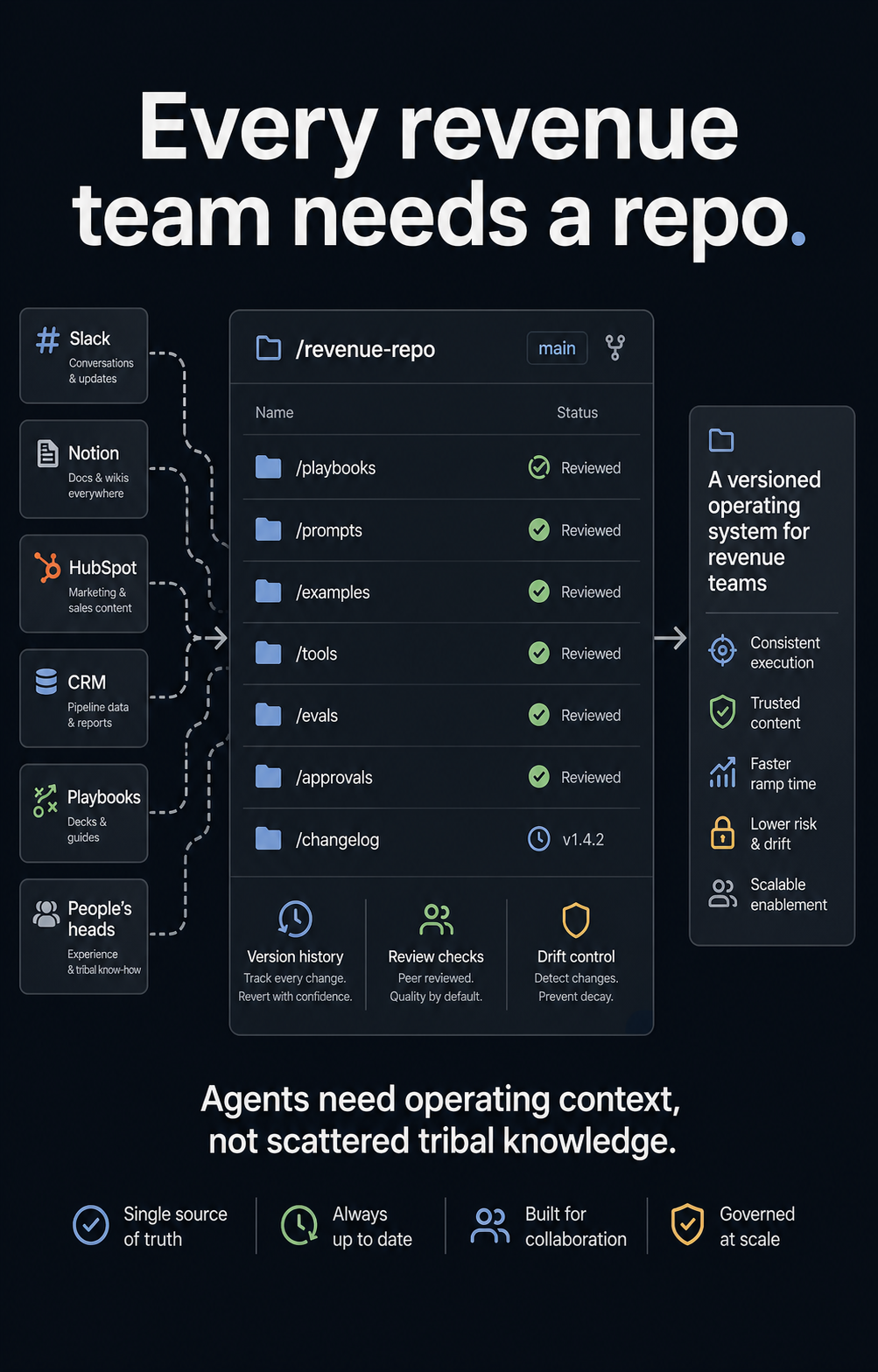
The more I work to speed up Wynter’s GTM process, the more I realize it’s not ready for agents if it only exists in Slack, Notion, HubSpot, and people’s heads.
Every revenue team needs a repo.
Not necessarily a codebase.
A repo in the operating sense: versioned, reviewed, testable, and clear enough that an agent can pick up a workflow without immediately making a mess.
Engineers and developers learned this ages ago.
If the desired state of infrastructure matters, you don’t leave it scattered across chat threads and tribal memory.
You put it somewhere versioned.
You review changes.
You test them.
You watch for drift.
Revenue teams are about to learn the same lesson, because agents don’t run on vibes. And we’re all going to be making a LOT of agents.
Big, small, multi-task, or single-task, they need:
-> clear instructions
-> canonical examples
-> tool definitions
-> edge cases
-> handoff rules
-> approval gates
-> data contracts
-> evals
And more. Not an exhaustive list. In fact, it is definitely missing some stuff.
Right now though, most GTM motion is the opposite.
The demo qualification logic is half in the CRM.
The objection handling is in someone’s Notion doc last updated in Q3 2024.
The renewal risk process lives in a Slack thread.
The “how we actually route enterprise accounts” rule is in one ops person’s head. (Look ma, that’s me.)
Then, in this dirty, undocumented, scattered mess, we ask agents to help with outbound, research, routing, forecasting, call prep, or deal inspection.
And when it gets weird, people blame the model.
Candidly, sometimes the model is not the problem.
The operating system is.
A revenue repo could be simple:
/revenue-repo
|-- playbooks
|-- prompts
|-- skills
|-- examples
|-- tools
|-- evals
|-- approvals
`-- changelog
Etc. Everyone’s will be customized, of course.
But make sure every meaningful workflow gets an owner, version history, good and bad examples, and tests that catch obvious nonsense before it gets near the CRM or any production systems.
I am thinking hard about how to not make this performative.
This is not about making our revenue team or GTM more technical for the sake of it.
I want to make our business legible to the autonomous workers we want to run parts of it.
And if our processes can’t be written down clearly enough for a smart junior hire to follow, an agent is screwed.
And once they start making a mess worse even faster, then we’re screwed.